AI audit: the questions to ask before you start automating
Articles
BLOG DETAILS26 FEB 20268 min read
A practical audit framework for operations and sales. Find your real bottleneck, define the right end-to-end system, and avoid expensive automation chaos.
AI audit: the questions to ask before you start automating
If you cannot name your biggest bottleneck, you will almost certainly automate the wrong process. And yet that is exactly what happens every week. A team sees an impressive demo, reads a post about AI agents, or hears that competitors are ?already doing automation.? Then they immediately start looking at tools, workflows, and integrations. Not the actual problem.
That is exactly why so many AI projects disappoint. Not because the technology is weak, but because the starting question is wrong. Something gets built that technically works, but creates little commercial or operational value. The result: more software, more exceptions, more maintenance, and still the same bottleneck.
A proper AI audit prevents that. Not by endlessly analyzing, but by making it clear where the process is breaking today, which steps are repeatable, where the data is weak, and which automation will actually improve capacity, cost efficiency, and customer experience.
At Next Shape, we never start with the question, "Which tool should we use?" We start with, ?Where is this business losing time, margin, speed, or leads today??
Many companies treat AI and automation like a separate layer they can simply place on top of existing processes. That is naive. Bad processes do not become good because of AI. They just get executed faster.
In practice, an AI audit is meant to clarify three things:
where the real bottleneck is
which processes are actually suitable for automation
which use case has the highest impact with the lowest implementation risk
That matters because not every manual process should be automated. Some steps genuinely require human judgment. Other steps look inefficient, but are not the limiting factor in growth. And others may be technically automatable, but practically unstable because the data is messy or spread across too many systems.
Without an audit, you usually end up with one of these three outcomes:
1. You automate something that is not a priority
The team saves time on a process that is not affecting revenue, delivery capacity, or customer satisfaction.
2. You build on bad input
The workflow looks smart, but breaks as soon as information is missing, mislabeled, or scattered across inboxes, spreadsheets, and disconnected tools.
3. You create automation chaos
You end up with fragmented flows, workarounds, and exceptions, without clear ownership or end-to-end visibility.
That is not an AI strategy. That is tool-driven improvisation.
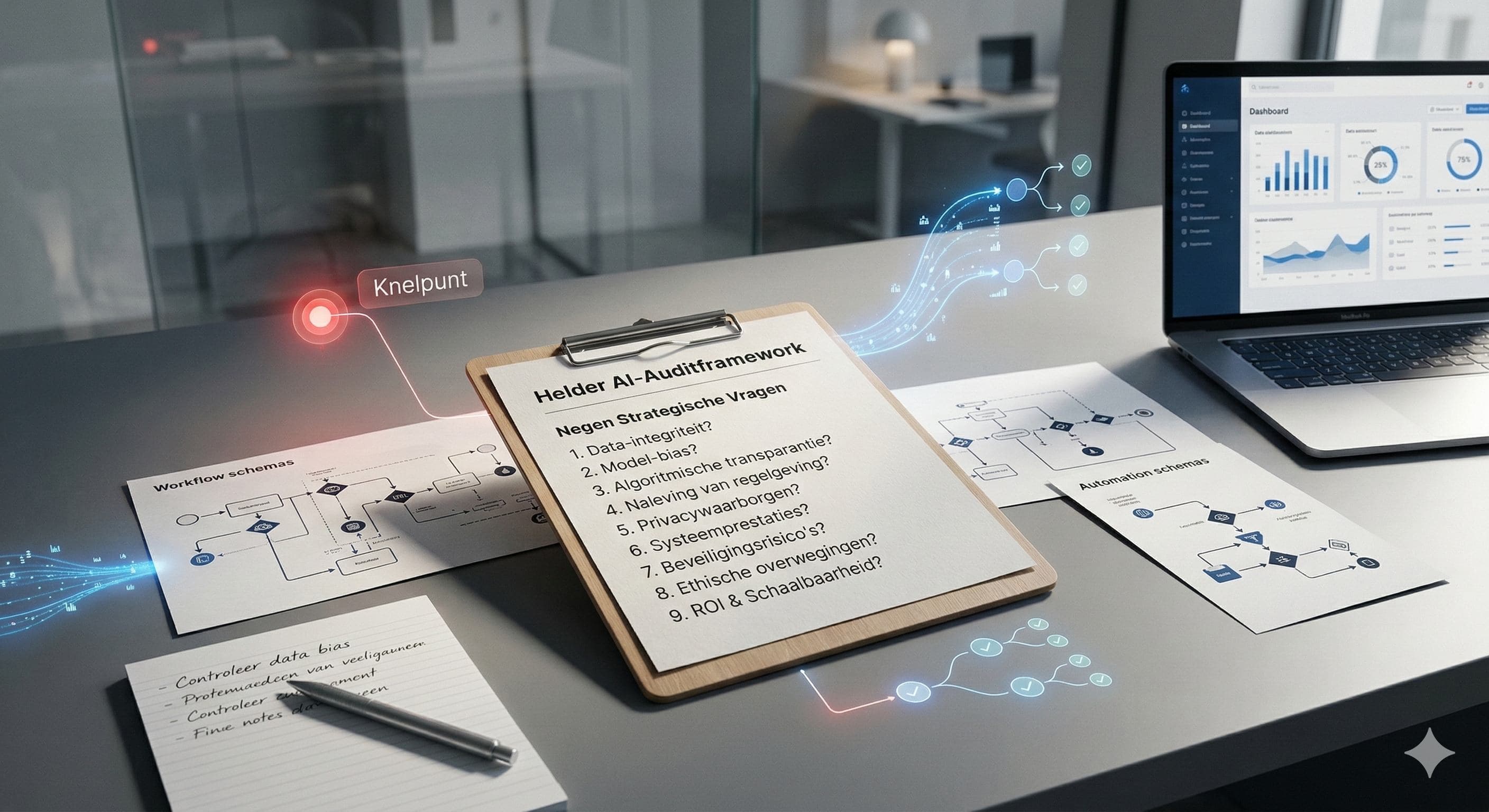
The AI audit: 9 questions to ask first
The questions below form a practical audit framework for companies that want to use AI and automation seriously in operations, sales, or service.
1. Where is the bottleneck if demand increases by 30% tomorrow?
"If we got 30% more customers, leads, or requests tomorrow, where would the process break?"
This is the first and most important question. Automation should not just save isolated minutes. It should unlock capacity where growth is currently getting stuck. That might be lead follow-up, onboarding, support, reporting, scheduling, or internal handoff between teams.
The mistake many companies make is automating an annoying task instead of the actual constraint. That feels productive, but changes very little in output. You shift work, but you do not increase throughput.
What to look for
delays between steps
tasks that pile up during busy periods
reliance on one person
heavy manual follow-up or reminders
mistakes that increase with volume
If you do not identify the bottleneck, you are building efficiency theater.
2. Which steps are truly repetitive, and which are not?
"Which actions happen the same way in 70 to 80% of cases?"
AI and automation perform best when there is a predictable pattern. Think lead routing, appointment confirmations, status updates, document generation, intake workflows, follow-up emails, or collecting and structuring inputs from forms and messages.
Not everything that takes time is suitable for automation. Strategic decisions, edge cases, escalations, and context-heavy conversations often still require human judgment. The goal is not to automate everything. The goal is to remove commodity work.
Good candidates for automation
moving data between systems
sending messages based on triggers
creating follow-up tasks
qualifying leads based on fixed criteria
summarizing or structuring information
recurring internal checks and notifications
Poor candidates for direct automation
processes without clear decision logic
exception-heavy work with lots of nuance
workflows that vary by employee
tasks where input is often missing or contradictory
3. Is the data complete, clean, and usable?
"Does the information we need actually exist, and is it stored in a reliable place?"
This is where many automations fail. Not because of the logic, but because of the input. An AI system can classify, summarize, and support decisions, but it cannot magically compensate for structural data chaos without limits.
If lead information is incomplete, customer data is duplicated, or statuses are tracked manually and inconsistently, every automation becomes fragile. Then you get incorrect triggers, failed handoffs, and unreliable reporting.
Audit points for data integrity
is critical information stored in one place or spread across systems?
are fields filled in consistently?
are statuses and labels reliable?
is there a clear source of truth?
are exceptions visible, or do they disappear into inboxes and chat messages?
A simple truth still applies: garbage in, garbage out. With AI, that rule matters even more.
4. Where is the process actually costing money or revenue?
"What is the business cost of this problem?"
Many teams describe bottlenecks too vaguely. They say a process is ?inefficient? or ?time-consuming,? but without a concrete business impact, prioritization becomes guesswork. A strong AI audit translates operational friction into commercial consequences.
For example:
lost leads because follow-up is too slow
higher payroll costs due to manual work
lost revenue because quotes are delayed or inaccurate
weaker customer experience because communication is inconsistent
less scalability because growth requires extra headcount
Once you know what the problem costs, you can decide whether the automation is worth building. Not every use case needs to be dramatic, but every use case should be commercially defensible.
5. Can this process be automated end-to-end, or only partially?
"Are we automating a complete flow, or just one isolated step?"
This is another common mistake. Teams automate one part of a process and call it a solution, while the rest of the chain remains manual, slow, or unclear. That creates a partially automated workflow that often needs even more coordination.
A strong AI audit looks end-to-end:
where does the input enter?
how is it validated?
who needs to act, and when?
what happens when the situation deviates?
how does the process end in a measurable outcome?
Example
A company automates the first response to new leads. That sounds useful. But if routing, qualification, follow-up, and ownership remain unclear after that, the impact is limited. In that case, the real problem was not the first message. It was the entire lead flow.
Automation delivers the most value when it improves a full chain, not just one isolated action.
6. What happens when something goes wrong?
"How does this process fail, and what should happen next?"
Most AI demos only show the ideal path. In the real world, everything depends on exceptions. A lead submits incomplete information. A customer sends duplicate requests. An integration fails. An AI model interprets something incorrectly. An employee changes a status manually outside the logic.
If you do not account for those scenarios during the audit, you are not building a robust system. You are building a fragile demo.
You need to define this upfront
which exceptions happen most often?
when should a human take over?
how is a failure made visible?
who owns recovery?
where is system behavior logged?
Good automation is not just smart when everything works. It is safe when something fails.
7. Who will own the process after go-live?
"Who owns this system operationally, not just technically?"
This is a massively underestimated issue. Automations get built, but once they are live, no one truly owns them. Then quality slowly degrades. Labels change, teams adapt their processes, exceptions increase, and eventually nobody trusts the system anymore.
That is why an AI audit cannot focus only on technology. It also needs to cover governance. Who maintains the logic? Who decides on changes? Who monitors output? Who handles incidents?
At minimum, you need
one process owner
clear KPIs
logging and visibility into performance
documentation of triggers, exceptions, and handoffs
regular review moments
Without ownership, even good automation turns messy over time.
8. What is the fastest route to measurable impact?
"Which use case gives the biggest return with the lowest risk?"
This is where the audit becomes practical. You do not need to do everything at once. In most businesses, the best first step is not the most innovative project. It is the most rational one.
Think of:
automating lead follow-up so inquiries do not get missed
structuring intake and qualification so sales stops wasting time
improving support triage so questions reach the right person faster
automating reporting so teams stop losing hours to manual updates
These use cases may feel less exciting than advanced AI concepts, but they often create faster efficiency gains, stronger scalability, and clearer cost savings.
The best first automation is usually the one that:
happens frequently
has clear boundaries
replaces a meaningful amount of manual work
has direct impact on revenue, service, or capacity
is easy to test and improve quickly
9. How will you measure whether the automation actually works?
"Which KPIs improve if this project succeeds?"
Without a measurement plan, you end up relying on vague impressions. Then you hear comments like, ?It feels faster,? or, ?The team seems positive about it.? That is useless if you want to manage for return.
A proper AI audit links every use case to measurable outcomes. For example:
shorter response time
higher lead-to-meeting conversion
fewer no-shows
fewer manual handoffs
fewer data errors
lower operational cost per process
higher customer satisfaction
more leads processed without additional headcount
AI and automation are not goals by themselves. They should produce visible improvement.
Where companies usually get AI automation wrong
After enough conversations with growing businesses, the same patterns keep showing up. Not because teams are careless, but because they jump to solutions too quickly.
They start with tooling instead of process design
That means decisions get driven by features instead of bottlenecks.
They automate tasks instead of systems
A single workflow might save ten minutes, but it does not fix the underlying process friction.
They underestimate data quality
The most impressive AI layer still fails if the source data is incomplete or inconsistent.
They ignore exceptions
That makes the system look good in demos, but unstable in production.
They do not measure business impact
Then nobody knows whether the project is actually creating value.
A practical example of a strong AI audit
Imagine a service business receiving leads through forms, WhatsApp, email, and ads. The sales team responds manually. Some leads get quick follow-up, others do not. There is no clear routing, qualification, or prioritization.
A weak approach would be: ?Let?s build an AI chatbot.?
A strong audit first looks at:
where leads are coming in today
how quickly follow-up happens
when leads are getting lost
which information is missing
how ownership is currently distributed
which manual steps every lead goes through
The conclusion is often much sharper. Maybe the business does not need a chatbot first. Maybe it needs an end-to-end lead intake system with source tagging, qualification rules, automatic routing, reminders, and human escalation for exceptions. That is less flashy, but far more valuable commercially.
That is the difference between applying technology and solving an operational problem.
The Next Shape approach
At Next Shape, an AI audit does not end in a thick strategy document that nobody uses. We use the audit to quickly determine where the process is breaking, which use case has the highest return, and what the first version of the system should look like.
Our approach is simple:
identify the bottleneck
map the workflow end-to-end
test data quality, exceptions, and ownership
choose the use case with the best impact-to-complexity ratio
turn that into a first working system or prototype
No months of consultancy. No vague innovation language. Just clarity on what is broken now and what should be built first to create measurable value.
Conclusion: do not start with AI, start with clarity
The biggest mistake in automation is not that companies lack tools. It is that they lack clarity on where the real gains are.
A proper AI audit forces you to understand the process before adding technology. That helps you avoid automation chaos, make better decisions, and build systems that do not just look smart, but actually improve growth, efficiency, scalability, and customer experience.
If you want to use AI seriously in operations or sales, do not start with "what is possible?" Start with "what is breaking right now?"
Want to know where your process is losing capacity, revenue, or speed today? Request our AI scan. We will map your workflow and show you where AI and automation can create the biggest impact.